 EDU Portal
Podcasting as a Bridge to Literacy: Elevating Student Voice
April 10, 2026A few years ago, I had a student we’ll call Johnny that never talked. Over the course of the school year, he uttered only a handful of words, often just staring back at me when I asked him a question. I didn’t know what to expect from Johnny when I introduced the Podcasting Unit. How would this super shy student record a podcast if he barely spoke?
To my surprise, Johnny immediately took to podcasting. Something about having a script, a microphone, and the ability to edit in Soundtrap really resonated with him. He created a podcast called Gamer Gang. His first episode was about his favorite series: Super Smash Bros. He dove into the history of the game, comparing and contrasting the many editions across different systems and digging into the evolution of the characters.
My jaw dropped when the podcast turned to an interview with a fictitious Gamer Gang coworker. He splashed reverb and autotune on his “coworker’s” voice to differentiate it from his own. I couldn’t believe what I was hearing. Not only was Johnny talking, but he created a character that was talking too! And he was utilizing the technology for dramatic effect. I always knew that Johnny had something to say—every student does! The problem was that we hadn’t given him the right way to say it.
Listen to the podcast below:
Podcasting as a Literacy Bridge
There are many students like Johnny. At first glance, they may seem disengaged or lacking capacity when in reality, they’re blocked by format. Traditional classrooms often prioritize academic language before students have fully developed their ideas, making it difficult for them to express what they actually think (as described in a recent post on the YPG blog).
Podcasting gives teachers a way to flip that process.
Instead of starting with formal writing, students can begin by speaking, using their home vernacular and natural voice to work through complex ideas. Teachers can then guide them from that initial expression toward the academic language expected in essays, reports, and research papers. In this way, podcasting becomes a bridge between how students think and how they are asked to communicate in school.
When students record, their thinking becomes audible. A podcast becomes a working draft. It is something they can listen back to, revise, and build from when it is time to write.
Podcasting also helps expand literacy development beyond reading and writing. Speaking and listening are core literacy skills, but they are often underdeveloped in traditional classrooms. To create a strong podcast, students need to communicate clearly, organize their ideas, and speak with an audience in mind. As they listen back and revise, they engage in the same kinds of decisions they would in writing. They clarify ideas, strengthen their line of reasoning, and make intentional choices about tone, pacing, and structure.
Podcasting for Equity & Inclusion
Let’s hold for a moment on the gap between academic language and home vernacular. Students are often meant to feel like the way they speak at home or with their friends is wrong. In many classrooms, the quality of their thinking is judged less by the strength of their ideas and more by how closely their language aligns with academic expectations. For some students, that creates a barrier to participation altogether, like my student Johnny.
Podcasting helps remove that barrier.
When students are able to tell their stories in their own words, their lived experiences and cultural identities are validated. They can focus first on what they want to say, rather than how they are supposed to say it. From there, teachers can guide them toward more formal academic language, building on their ideas instead of replacing them.
When done well, podcasting also aligns with Universal Design for Learning principles by creating multiple entry points for participation. Students can contribute through speaking, listening, interviewing, producing, or editing. Each role offers a legitimate way into the work, allowing more students to engage meaningfully and take ownership of their learning.
In this kind of environment, more students are able to participate, more perspectives are represented, and more voices are heard.

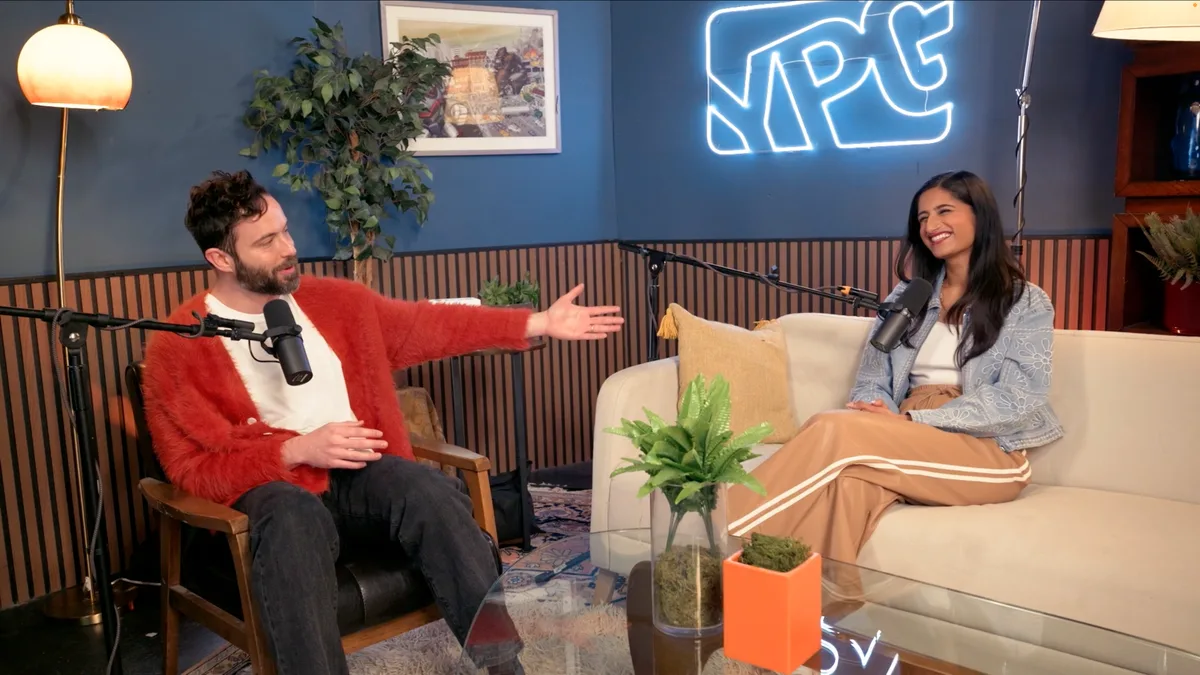
Lawrence Grey on set with YPG Podcast Resources’ co-host Arasha.
YPG Podcasting Resources
At Young Producers Group (YPG), we design project-based learning materials and experiences that help teachers bring creative, industry-aligned work into the classroom.
The YPG Podcasting Resources guide students from initial ideas to fully realized podcast episodes through a clear, scaffolded process. Along the way, they build skills in planning, writing, recording, editing, and reflecting, all within a framework centered on voice, audience, and intention.
For teachers, the goal is simple: bring podcasting in the classroom within reach. Structured units, classroom-ready prompts, and graphic organizers support each stage of the process, while pacing guides and rubrics provide clarity and consistency, even for those new to audio production.
If you’re looking to bring this into your classroom, you can explore the resources and sign up for a free trial to see how it works in practice.

Lawrence and Arasha about to use Soundtrap to record a podcast in the Media Unit of the YPG Podcasting Resources.
How many students like Johnny are sitting in our classrooms right now?
When we expand the ways students can communicate, we expand who gets to participate. And when more students are able to share their thinking, the classroom becomes what it should have been all along: a place where every voice has the opportunity to be heard.


